Showing posts with label brett. Show all posts

Sunday, 14 July 2019

Herb table beer

After lacto fermenting some carrots, I decided to use the brine to inoculate some unhopped wort made from spraymalt.

After a few weeks of sitting there I put a small amount of the Wilner Brett strain in the mix.
At my allotment my chamomile and lemon balm was taking over the herb patch, so great bunches were cut, leaves and flowers. I made more wort with spraymalt, and boiled the herbs in for about 5 minutes. I don't know the exact weight of herbs but the impression was about the same ratio of herb to water as I would normally use when boiling spaghetti. Enough water to cover plus a bit of space in the middle...
Medieval precision aside, the wort was allowed to cool and pitched on top of the lacto sour. After 12 hours a some dry Nottingham was sprinkled on top. The gravity was probably about 1.040.
Entirely separately I turbid mashed a 90 percent lager malt 10 percent rolled oats grist to give a 1.035 wort. Hopped with 20 IBU of Fuggles, and inoculated only with bottle dreggs from some saisons including Brett for a few days. Then the St Austell brewery strain was pitched. After a week it was dry hopped with 0.5 g per litre of Fuggles and spent three days on the hops.


The sour was very sour, and the turbid stock ale was slightly smokey. I blended a bit of each using a pipette and the result was much greater than the sum of the parts. After a bit of messing about I decided on 60 - 40 stock to sour. Each was racked in the right proportion to a new bucket. After three days of melding the mix was bottled to 3.0 vols in 750 ml champagne style bottles which were capped.


The finished beer is a good level of sour. The lemon balm gives a tea like flavour, rather than fresh lemon, which gives a more lemon-curdy taste. I think this beer might have been better as not a sour. The herb aromatics would add pungent floral flavour to a hoppy beer. As it is the sourness just cuts through the floral too early. If this was re-brewed, I'd stick to a clean saison yeast and load it up with Sazz. It is hard to tell with so much going on, but I think the turbid mash adds an interesting grainy flavour.


Sunday, 19 May 2019

Chamomile Saison

I decided to enter a beer to a competition. What better category than herb vegetable or spice beer!

I had a bunch of chamomile from the allotment. Siobhan also brought me some chamomile flowers from work. I had already brewed this beer with broad beans. I thought it worked well, and decided to brew with beans again. This time I wanted to use dried beans because somebody on 'milk the funk' mentioned my poor extraction last time might have been because my beans were still hydrated, whilst most ingredients are dried when weighing them for a recipe. I used a ten bean mix. Initially I was going to malt them, but my malting experiment turned into a smelly mess, so I decided to just use dry packet.

The beans provide starch and protein, and the point of them was to increase mouthfeel in a low gravity beer, as well as some longer chain sugar for Brettanomyces to metabolise. In my previous beer I felt they also contributed a nice fresh but barely detectable pea/bean aroma.

The beer was 5% acid malt, 25% beans (assuming same extract potential as wheat) and 70% pale malt. The beer was 1.035 OG. the beer was bittered with Fuggles (I think!?) to 27.5 IBU and finished off with 10g of my allotment hops (mix of Fuggles and Goldings) in a 10 L batch with 10 minutes left (or no chill equivalent).

The beer was then fermented with yeast cultured from my previous batch of spelt Saison. This was mangrove jacks Belgian ale + a Brett strain, which was either Brasserie de la Senne's Bruxellensis or Orval. This problem of misidentification which started with this batch will soon come to an end, as I think I'll start with new yeast for the next batch of Saison in the summer.

The beans were hydrated/boiled for an hour before adding to the mash. My gravity was again a little low, suggesting that beans just don't contribute many sugars regardless of if they are dried or not. The liquid from the beans was purple, which I was a bit worried about, but the finished beer was a nice pale yellow. The beans really do flesh out the body of the beer, you'd not guess it it was only 1.035.

As for the chamomile, most was added at flameout, according to the recommendations in Phil Makowskis's 'Farmhouse Ales'. At bottling time, a tea was made in a French press and added just to boost the flavour a bit. I suspect the flowers added some bitterness, as the impression of this beer is quite bitter.

I've not had many chamomile beers before. This had a definite witbier feel to it, which is nice. It also had a phenolic flowery flavour. None of the nice fresh bean aroma is there in this batch, unsurprisingly, since the beans were dried. At times I feel I've been able to detect a bean flavour, that is, kidney beans, but this isn't always detectable. Despite my criticisms this beer is nice, I like the bitter dry expression, and being honest I would happily brew this again. The fact that it is 1.035 and relatively satisfying to the mouth is also very pleasing, a great table beer with a salad and some nice funky cheese. Would probably reduce the bitterness slightly next time.


The judges had mixed views. I got a score of 31, but the criticism was almost equal and opposite. One thought flavour was very noticeble, one too weak, etc. I, in the end, lost to a chile chipotle porter.

Pretty happy with this beer. A bit rough but I feel there is genius waiting to sneak out. The head is fabulous, I wonder if wheat or other grains would give retention as good.

Saturday, 20 October 2018

Vintage IPA

I grow hop bines on my allotment. The Fuggles bine is extremely vigorous, the Goldings is pretty pathetic in comparison; It produces far fewer cones.


The hop harvest was early September, and I was blessed with a decent pile of fresh English hops. I have no facility to vacuum pack hops in nitrogen flushed bags protected by cyro leviathans armoured with the frozen tears of married women from within the walls of Carcassonne so timely use of the harvest was my strategy to prevent oxidative degradation of said hops.


A vintage IPA seemed to make sense. There are some good ones in "A Homebrewer's Guide to Vintage Beer" R. Pattinson. From that book I knew the idea behind this beer would be 100 percent pale malt, a ton of whole leaf hops early in the boil, sulphate rich water, and that the beer should be aged for a year  or so with Brettanomyces.


Recipe

100% Pale (Crisp, flagon). OG 1.055. In 15 l of beer it was 130 g of  Fuggles at 75 mins, 130 g at 60 mins and 130 g at 30 mins. The sulphate was around 350 ppm to 100 ish ppm chloride.

The whole hops absorbed a lot of beer, something to bear in mind if you are attempting a recreation. Almost the whole volume of the beer was saturating the enormous pile of hops, and even with a decent squeeze of the hops in a muslin bag, I still lost a fair bit of wort.

The beer was fermented with WLP002 cultured from a bottle of honey mild. I'm afraid a Brett strain may have been in that bottle, and now the beer is infected. Unfortunately I have noticed some slightly medicinal flavours, but since I don't really need the demijohns I'll just let it ride out.

Just a year to wait....


Sunday, 26 August 2018

Broad Bean Saison

On my one of the few things that will overwinter on an allotment in the UK is broad (fava) beans. A variety called "Sutton" was grown on mine, and I ended up with a couple of kg of the beans, which were blanched and then frozen. They then remained in the freezer for a year, taking up space.

They probably had been left on the plant a bit long and had got quite large and starchy. I remembered that one of the things a turbid mash is supposed to do is to contribute starches for microbes. The idea behind this being that sacc can't metabolize the starches but other bugs can.

 Someone has hypothesized that Brett doesn't really need much left behind because it can metabolise other stuff, so turbid mashing is really for other bugs, so what I'm doing doesn't make a huge amount of sense, but still.

I wanted to have another go at a saison with brett and thought the beans would be a rustic addition to a rustic beer.


I must say I was slightly inspired by CJJ Berry's excellent wine making book where the broad bean wine is celebrated as surprisingly good.  He suggests boiling the beans to extract whatever they contribute, but he suggests not letting the skins split to help the wine clear later. I'm not sure whether this is to stop protein or starch getting in the wine, but I decided I wanted both in my beer, so mashed the beans periodically with a potato masher. 

The 500g of beans started out a lovely green in 2 liters of water. At the end of an hour or so there was almost zero fresh bean aroma left and I had a grey looking sludge. This set in the fridge to a grey jelly, which hopefully means the beans had gelatinised. I froze it to preserve the goodness until I came to brew my saison.

The frozen block of beans was added to the inside of my BIAB bag, and swirled in the mash water while it heated. It surprised me how long it lasted in 70 degrees C water and actually it meant the mash water climbed all the way to 72 before it had melted the block. Adding a kilo of barley malt to the mash lowered the temperature to 68-9 degrees.

The recipe for this was 64% barley malt and 36% unmalted boiled frozen broad beans (by extract). I guessed that the extract potential of a broad bean was 1.038 which is the same as wheat as suggested in "designing great beers" by Ray Daniels. I use custom "software" to design my recipes in the form of a spreadsheet based on information from this excellent book. I wanted a very low gravity saison, I shot for 1.035 anticipating I might come a little short and 1.030 wouldn't be the worst thing in the world.

For this one I wanted to adjust my water. Bristol water is generally good for medium dark beers (bitters?). For lighter recipes, I generally have to lower the PH using a bit of HCL, and, either gypsum or calcium chloride depending on the desired sulphate-chloride ratio. The use of HCL to lower the PH normally means it is  difficult to get chloride levels bellow 150ppm-ish. For this recipe it didn't really matter and I hoped to achieve the following profile (ppm).

 
Ca Mg Na Cl SO4 HCO3
98 4 25 147 144 0.6


I'd read on a forum thread, where a bloke reports on malting lentils, that he got an iridescent shine on the bubbles on his brew. I sort of noticed the soap bubble like effect in the mash, but once the boil began the bubbles became much tighter and more matt tan. The photo below is after transfer to the fermentation vessel.


I take gravity readings at the start of the boil and then calculate what volume to brew to to get required gravity. The wort was a normal looking colour, not too grey.


This one was at 1.024 for 11L of collected wort. I chose to boil down to 9L to get final gravity of about 1.030. The wort actually boiled down much faster than expected so I had to add water to the fermenter to top up. It also darkened quite a bit. (See photo above above). This suggests the actual extract potential of broad beans is almost zero.

I used 10g of northern brewer at 60m mins for 21 IBU and then 10g of my allotment hops (mainly fuggles with a little bit of EKG) at 30mins for a further 3 IBU. This was more a romantic gesture as the beans and hops would have grown side by side last season (or saison?). No late hops for this one. The BU to GU ratio was 0.8. Refreshing but not too mouth stripping.

The wort was transferred to a brew bucket and a half package of mangrove jacks Belgian ale was pitched after an overnight cool. The yeast had been hanging around for a while (open but pegged shut). The brett I got originally  from some bruxellensis dreggs  (or was it orval? Who knows. Oops.) was pitched after 1 or 2 days. After a week or so I pitched burning sky's "saison a la provision" dreggs. I wasn't sure if I'd get much lacto expression due to the hopping.

 The beer was excellent, It was a lovely hazy yellow, the brett was very subtle and the lacto was non-existent. It just had a very bright slightly winey pale bright light flavour. This was an excellent table beer. I'm not sure what the beans really added, but suspect some of the clean fresh flavour might be from them, as well as a possible contribution to the body, although I may be completely deceiving myself based on psedo-scientific predictions about what the beans should do. I think because this was so low gravity the saison yeast was not so phenolic as it would be in a higher gravity example, which I much preferred.


One criticism would be that the hop character was a bit dull and one dimensional, a sort of slow lump of dreary just-bitter. If I were to re-brew, I would probably do either a large late addition of some floral noble hops, or I think it would work to just go wild and stick in something daft like galaxy in a large dry hop.

Excellent low gravity beer.

Tuesday, 10 July 2018

Blended Brett Brux Belgian Beer Bisected Batch

A belgian pale ale. This one was split two ways, one with brett brux from orval, one with brett brux from brasserie de la senne's bruxellensis. One bottle was kept clean, just for comparison purposes.

It was 80% pale (flagon, crisp), 10% sugar syrup I made from beet sugar mixed with water in a pan, which was a light honey colour, and 10% torrefied wheat. I just entered the syrup in the recipe calculator as sugar and accounted for the weight of the water. Aimed for a gravity of 1.040. Hops were 15 g of mandarina bavaria at 45mins for 17 IBU and 10g of homegrown mixed goldings and fuggles at 5 mins for negligible IBU (<2 I imagine).  Yeast was mangrove jacks M47 Belgian abbey. I slightly under-pitched by using a quarter of a packet in a 10L batch in order to promote esters.

The beer was fermented in a 10L bucket, then after primary was racked into two 5L demijohns and one bottle. The bottle was primed with sugar and the two demijohns had one type of brett each and then was fitted with an airlock and left for a couple of months.

The beer was a bit darker than I was expecting. I don't know if this was from the torreffied wheat.

Tasting. I accidentally tried the clean portion separately to the others. It had a very pleasant fruity estery  flavour initially, then there was a quite firm bitterness, which was satisfying in itself but clashed a bit with the yeast and then developed to a slightly strange astringent soapy aftertaste as the hops and yest fought to control the slightly thin finish. I'd probably add some wheat and down the bitterness next time, or just use an english yeast and mash a bit hotter for a nice bitter.

To free up some space in the kitchen I decided to blend the two Brett versions with a pale sour blend I had on the worktop for about a year. The details of that beer are a little hazy, but I know it is a mix of sourdough starter fermented 100% pale malt and repitched lager yeast in a sort of mainly honey and a tiny bit 25%? pale malt wort. The taste is apricots and honey. Really amazingly nice and not really sour, about the same as a sourish apple. A few sourdough notes. I doubt I could ever recreate this exactly, but might try something similar. 


On the left is a pale sour, and the right is one Brett Belgian pale ale.

The blend ratio was 3:1 pale ale: sour. I chose to carbonate to 3 vols of CO2. This was because both beers were pretty flat after a few months of aging. If the Brett takes it up .6 vols I'm still probably ok for bottle strength, if actually it doesn't and there is no CO2 currently in the beer I'm still at a respectable 2.4 vols.


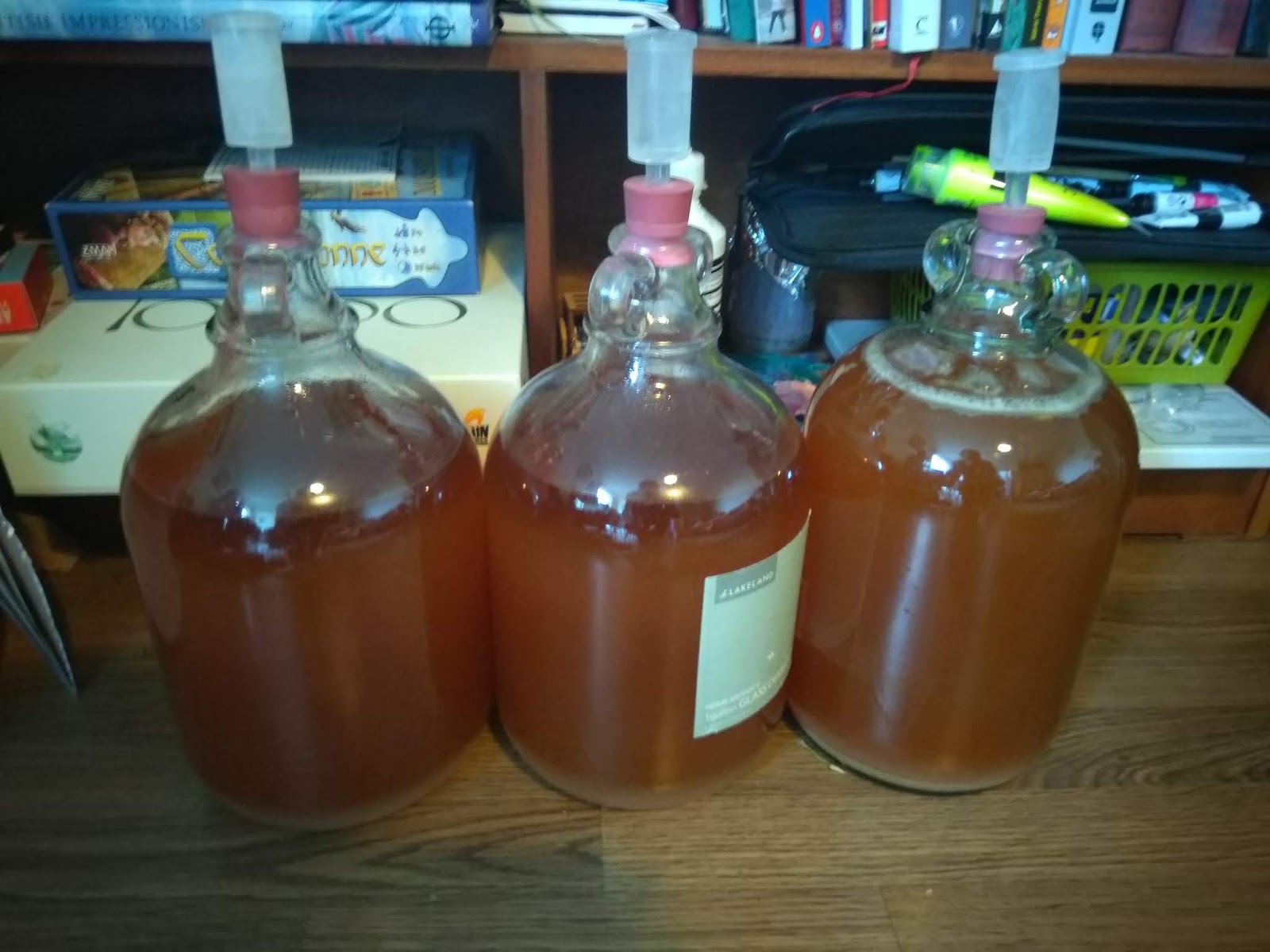
The three amigos post racking.

I must confess, I made a few blunders. One airlock ran dry on one carbouy causing a pellicle to form. I also forgot which batch was which. Finally in the second batch I got a load of the lees into the bottling bucket, causing it to be much cloudier than the other batch. At this poiny I don't think I can really make a fair comparison. 

But anyway, to the tasting!


Above is a photo of both beers. The one on the left had poorer head retention. The one on the right was much fruitier, and had the perception of being sourer. The one on the left, which I think I recognise as the orval Brett, had more of a minerally character. Both beers were very dry. Whilst I'll wait a bit longer for things to marry, as they only had a week or two in the bottle, the beers seemed a bit disjointed. A sort of microbial mess. I preferred the sourer one which had a sort of generic red soft fruit flavour, whilst the minerally one was more harshly Brett at first and then made a suggestion of pink grapefruit squash to my ever listening taste buds. If the bitterness fades and the bugs start to get along a little better these could be nice, but at the moment they are just so so. A final thing to note is I was surprised how light in colour each beer was. As each blend was mostly brownish beer it was a shock to get honey gold out. 


Monday, 18 June 2018

Spelt Brett Saison

I have really been enjoying Amos Browne's blog. One of the articles talks about his spelt saison recipe. I thought I would give it a try.

I decided to use spelt flour. This was mainly because it was easy to get, and I was confident that by mixing the flour with the grain first, my BIAB system would handle the slightly stickier mash.

The plan was to pitch some brett bruxellensis from a bottle of orval after primary fermentation was underway to get a bit of brett character in the final beer.

I used 80% pale malt (Crisp, Flagon) and 20%  organic spelt flour from dove farms. I aimed for a SG of 1.045 meaning if it really attenuates to 1.002 it is 5.64% abv. I didn't want to go much lower due to concerns about lack of mouthfeel. Bittering was with fuggles at start of boil to 28 IBU. I later dry hopped with some (15g for 10L batch) mandarina bavaria. Water was adjusted with sodium chloride and gypsum to make something vaguely like one of the water profiles in farmhouse ales, although from memory I struggled to get chloride down to the right level. Mash was single infusion BIAB at 65 C.

Yeast was mangrove jacks M27 Belgian saison ale.

Yeast was pitched, and shortly after (1 day?), brett from a relatively fresh (< 6 months) bottle of orval was pitched. Beer was left for 4 weeks, signs of airlock activity finished after 3.

I made an absolute hash of bottling. Aiming for 2.6 vols of CO2 (just in case brett takes it up further)  I had to add a liter of water to make up enough liquid for how much sugar I added to the bottling bucket, then the sugar didn't all dissolve which I noticed post bottling, so I quickly dissolved the remainder in some hot water then used a pipette to dose each bottle proportionally (I was using some 500ml beer style bottles and some 750ml champagne style bottles). Plain table sugar was used. This would normally be completely fermented by brewers yeast so I wasn't worried about the brett over-carbing, since, it too, will simply use all of it. I also gave it longer than normal to complete fermentation so hopefully no bottle bombs. Orval reportedly leave it three weeks.


The beer poured a golden yellow with a weird sudsy head that lasted a few minutes. Carbonation was high with big bubbles and quite a carbonic bite. Since brewing this beer I have had a commercial lager beer with mandarina bavaria hops, and I have determined that I don't like the tangerine pithy taste. When this beer was first tasted, the thin mouthfeel from the brett combined with the (to me) slightly unpleasant fruity bitterness combined with slight brett funk made it a little bit like when one gets a little bit of sick in one's mouth after eating an orange and then running about. However, with time the hops faded and the brett became a little bit more assertive, which was better. The weather warmed up a bit too, which made the dryness of the beer more pleasant. If I was doing this beer again I would probably get rid of the later hops and maybe add some calcium chloride to try and round out the flavor a bit.